|
Monascus Red

Collect
商品说明
Introduction Monascus pigment is a high-quality natural food pigment fermented from filamentous fungi of the genus Monascus. It is a secondary metabolite of Monascus. Monascus pigment, whose trade name is Monascus red, is a natural red pigment made from rice and soybeans as the main raw materials, through liquid fermentation, extraction, concentration and refinement of Monascus, and from Monascus rice as the raw material, through extraction, concentration and refinement. Ingredients Monascus pigment, also known as Monascus red, can be obtained by deep culture of Monascus or extraction from Monascus rice. Monascus pigment has a variety of pigment components. Generally, the crude product contains 18 components. The structures of the 6 components have been determined as follows:
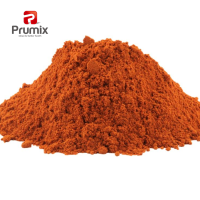
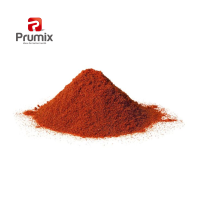
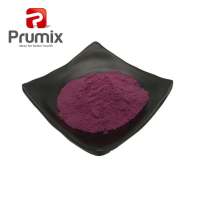
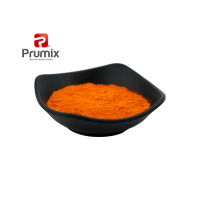
Physical and Chemical Properties Monascus pigment is dark purple-red powder with a slight odor and a melting point of 165~192℃. The fat-soluble pigments in Monascus pigment can be dissolved in solvents such as ether, chloroform, ethanol, acetic acid, and n-hexane. The solubility of acetic acid is the highest, and that of n-hexane is the lowest. Commonly used solvents are ethanol and acetic acid. The solubility of Monascus pigment is best when the concentration of ethanol is 75%~82% and the concentration of acetic acid is 78%. The solubility of Monascus pigment in water is related to the pH value of the aqueous solution. It is very easy to dissolve under neutral or alkaline conditions, but its solubility tends to weaken in the acidic range below pH4.0 or in a salt solution containing more than 5%. When the content of Monascus pigment is low, its solution is bright red, and when the content is high, it is dark brown and accompanied by fluorescence. It has excellent coloring performance for protein. Once dyed, it will not fade even after washing. 1 Stability to pH The effect of pH on Monascus pigment is more complicated, and the effects on each component of Monascus pigment are also different. Generally, red pigments are relatively stable in the neutral range, and neutral is preferred even when heated. However, in the case of acid and alkali, alkalinity is better than acidity, and the loss rate is lower. 2 Thermal Stability Research has shown that red pigments have good thermal stability, which is better than other synthetic pigments, and their heat resistance is also excellent among natural pigments. 3 Light Stability The alcohol solution of red pigments is less affected by ultraviolet rays, but sunlight can reduce the chromaticity. Through the experimental analysis of the light stability of red, orange and yellow pigments in red pigments, it was found that the light stability of red, orange and yellow pigments in red pigments is very different. The yellow pigment has the strongest light stability, followed by the red pigment, and the orange pigment is the most unstable to light. 4 Stability to Other Substances Practice has proved that red pigments are not affected by common metal ions and oxidants and reductants. 5 Antibacterial Property Antimicrobial tests on 54 easily contaminated microorganisms in food proved that red pigment has a strong inhibitory effect on Bacillus cereus, Bacillus mycoides, Bacillus subtilis, Staphylococcus aureus, and Pseudomonas fluorescens. 6 Antioxidant Activity Three antioxidant models, hydroxyl free radical system, superoxide anion free radical system, and diphenyl hydrazine free radical system, were used to verify the antioxidant activity of red pigment, proving that red pigment and orange pigment of red pigment have strong free radical scavenging ability, and the red pigment component has the best antioxidant property. Use Used as food colorant |